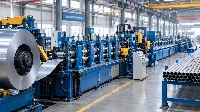
In the metal processing industry, selecting the right rolling equipment is crucial for achieving production efficiency, product quality, and cost control. Among the most widely used technologies, cold rolling mills and hot rolling mills serve different manufacturing purposes and offer unique advantages.
Understanding the differences between these two types of rolling mills can help manufacturers make informed investment decisions and optimize their production processes. MIVI provides both cold rolling and hot rolling solutions for a wide range of steel processing applications.
What Is a Hot Rolling Mill?
A hot rolling mill processes metal above its recrystallization temperature, allowing steel billets or slabs to be deformed more easily. During the hot rolling process, thick raw materials are reduced into plates, strips, bars, or structural sections through multiple rolling stages.
Advantages of Hot Rolling Mills
- High production capacity
- Suitable for large reduction ratios
- Lower deformation resistance
- Cost-effective for bulk production
- Improves the internal structure of cast materials
Hot rolling is commonly used for:
- Structural steel
- Construction materials
- Heavy machinery components
- Shipbuilding materials
- Pipeline steel products
Because hot rolling focuses on productivity rather than surface appearance, hot-rolled products typically have wider dimensional tolerances and rougher surfaces.

What Is a Cold Rolling Mill?
A cold rolling mill processes metal at or near room temperature. After hot rolling, the material undergoes additional rolling passes to improve thickness accuracy, surface finish, and mechanical properties. MIVI's cold rolling equipment utilizes advanced thickness control systems to achieve high-precision results.
Advantages of Cold Rolling Mills
- Superior surface quality
- Higher dimensional accuracy
- Improved strength through work hardening
- Better flatness and consistency
- Ability to produce ultra-thin strips
Modern cold rolling mills can manufacture products with excellent thickness tolerance and smooth surfaces, making them ideal for precision manufacturing industries.

Cold Rolling Mill vs Hot Rolling Mill
| Feature | Hot Rolling Mill | Cold Rolling Mill |
|---|---|---|
| Processing Temperature | Above recrystallization temperature | Room temperature or near room temperature |
| Production Efficiency | Very high | Moderate |
| Surface Finish | Rougher surface with oxide scale | Smooth and clean surface |
| Thickness Accuracy | Standard tolerance | High precision tolerance |
| Product Strength | Good toughness | Higher strength due to work hardening |
| Typical Thickness Range | Usually thicker materials | Can process very thin materials |
| Investment Focus | High-volume production | High-value precision products |
Manufacturers should choose the solution that best matches their production goals rather than focusing solely on equipment cost.
Which Industries Prefer Cold Rolling Mills?
Cold rolling mills are widely used in industries where appearance and precision are critical, including:
- Automotive manufacturing
- Home appliance production
- Stainless steel processing
- Electrical equipment manufacturing
- Precision tube and strip production
These industries require consistent thickness, tight tolerances, and superior surface quality to meet strict quality standards.
Which Industries Prefer Hot Rolling Mills?
Hot rolling mills are commonly selected for applications requiring large production volumes and structural strength, such as:
- Construction steel
- Infrastructure projects
- Heavy equipment manufacturing
- Shipbuilding
- Energy and pipeline industries
For these sectors, production efficiency and material throughput are often more important than surface finish.
The Combination of Hot Rolling and Cold Rolling
In many modern manufacturing processes, hot rolling and cold rolling are not competing technologies-they work together.
A typical production route may involve:
- Hot rolling to reduce the material thickness quickly.
- Pickling and surface treatment.
- Cold rolling for final thickness control and surface enhancement.
Many high-end steel products, including automotive sheets and precision strips, are manufactured using this combined process.
Conclusion
Both cold rolling mills and hot rolling mills play essential roles in modern metal manufacturing. Hot rolling mills deliver outstanding productivity and cost efficiency for large-scale production, while cold rolling mills provide the precision, surface quality, and mechanical performance required by advanced manufacturing industries.
The right choice depends on your product specifications, production volume, quality requirements, and long-term business goals. By understanding the strengths of each process, manufacturers can invest in the most suitable rolling solution and remain competitive in today's evolving metal processing market.