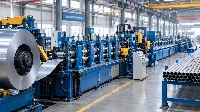
Pipe making machines are of utmost importance in the manufacturing sector as they are responsible for producing pipes used in various applications.
These machines are designed with precision and complexity to meet different production requirements. Structurally, a pipe making machine usually consists of a feeding system, a forming section, a welding or bonding unit, and a cutting mechanism. The feeding system ensures a continuous supply of raw materials, such as metal strips or plastic granules depending on the type of pipe being made.
In the forming section, the raw materials are shaped into the desired pipe profile. For example, in metal pipe production, rolls and dies are used to gradually bend and form the metal strip into a circular shape. In plastic pipe manufacturing, extrusion techniques are employed where the molten plastic is forced through a die to form the pipe.
The welding or bonding unit is a critical part, especially for metal pipes. High - frequency welding or other welding methods are used to join the edges of the formed pipe together, ensuring a strong and seamless connection. In plastic pipe production, some machines use fusion welding or adhesive bonding techniques to create a reliable joint.
The cutting mechanism is used to cut the pipe to the required lengths. It can be programmed to make precise cuts based on the specified dimensions.
Pipe making machines are widely used in industries such as construction, plumbing, oil and gas, and irrigation. Different types of pipes, including steel pipes, PVC pipes, and HDPE pipes, are produced by these machines to meet the diverse needs of these industries. The quality of the pipe making machine directly affects the quality of the pipes produced. Therefore, continuous research and development are focused on improving the efficiency, accuracy, and reliability of these machines to produce pipes with better quality and performance.