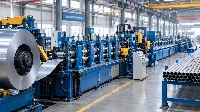
The production process of a tube mill is a meticulous blend of advanced technology and precision engineering. It commences with the sourcing of high-quality steel coils, which undergo rigorous inspection to ensure material integrity. These coils are then fed into the mill, where they're progressively formed into a tubular shape through a series of rollers, known as the forming section.
The forming process precisely bends and compresses the steel strip into a circular cross-section, while maintaining strict control over dimensions and wall thickness. Subsequently, the formed tube enters the welding station, where a high-frequency induction coil melts and fuses the edges together, creating a seamless joint.
After welding, the tube passes through sizing and straightening rollers to ensure dimensional accuracy and straightness. Next, it undergoes cooling, either naturally or through water quenching, to stabilize the metallurgical structure and enhance mechanical properties.
Subsequent stages involve cut-to-length, end finishing, and non-destructive testing (NDT) such as eddy current or ultrasonic inspections to detect any internal defects. Finally, the tubes are visually inspected, labeled, and packaged for shipment to various industries, including construction, automotive, and oil & gas, where they serve as critical components in infrastructure and equipment.
This comprehensive production process, from raw material to finished product, underscores the tube mill's capability to deliver high-performance, reliable tubing solutions tailored to meet the most demanding applications.