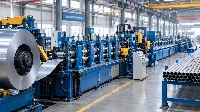
In modern tube manufacturing, production efficiency is influenced by much more than the rated speed of a tube mill line. Material quality, forming accuracy, welding stability, tooling condition, line configuration, and process control all have an impact on the final tube quality and overall production performance.
For manufacturers investing in a new Tube Mill Machine Line or upgrading an existing production line, understanding these factors can help improve productivity, reduce material waste, and maintain consistent product quality.

1. Raw Material Quality
The quality of the steel strip used as the raw material has a direct influence on tube mill performance.
Factors such as strip thickness, width tolerance, material grade, surface condition, and mechanical properties can affect the forming and welding process. Variations in the incoming material may lead to unstable forming, dimensional deviations, or welding problems.
For this reason, manufacturers should select suitable steel coils according to the required tube specifications and production process.
2. Forming Accuracy
The forming section is one of the most important parts of a tube mill line. During production, the flat steel strip passes through a series of forming rolls and gradually takes the desired tubular shape.
Proper roll design and accurate adjustment help maintain stable forming conditions. If the forming process is not properly controlled, problems such as uneven tube shape, excessive stress, or dimensional variation may occur.
For high-quality tube production, the forming process needs to remain stable throughout continuous operation.
3. Welding Stability
For welded tube production, welding performance directly affects the integrity and quality of the finished tube.
An unstable welding process can result in defects such as incomplete bonding, inconsistent weld seams, or excessive heat input. Appropriate welding parameters, material preparation, and equipment adjustment are therefore essential.
Depending on the application and material, different tube mill configurations can be designed to meet specific welding requirements.
4. Roll Tooling and Alignment
The condition and alignment of forming rolls and other tube mill components have a significant impact on tube quality.
Rolls that are incorrectly aligned or improperly adjusted can cause uneven forming forces and increase the risk of dimensional deviations. Over time, wear on the tooling can also affect production stability.
Regular inspection, accurate alignment, and proper maintenance of tube mill components can help maintain consistent production performance.
5. Production Speed and Line Configuration
Higher production speed does not always mean better overall productivity. The optimum line speed depends on factors such as tube diameter, wall thickness, material grade, welding method, and required product quality.
A well-designed tube mill line should balance production speed with forming stability, welding performance, cutting accuracy, and downstream processing.
The overall configuration of the production line should therefore be selected according to the manufacturer's actual product range and production targets.
6. Automatic Control and Process Monitoring
Modern tube mill lines increasingly incorporate automatic control systems to improve process stability and reduce manual intervention.
Monitoring and control systems can help operators manage important production parameters and identify abnormal conditions during operation. Automation can also improve repeatability when producing large quantities of tubes with consistent specifications.
For manufacturers handling multiple tube sizes or frequent production changes, appropriate automation can improve operational flexibility.
7. Maintenance and Equipment Condition
Even a well-designed tube mill line requires regular maintenance to maintain stable performance.
Key maintenance areas may include:
- Forming and sizing rolls
- Welding equipment
- Bearings and transmission components
- Cutting systems
- Lubrication systems
- Electrical and control systems
Preventive maintenance can help identify wear or abnormal conditions before they develop into major production problems. It also helps reduce unexpected downtime and extend equipment service life.
How to Improve Tube Mill Line Performance
Improving tube mill performance requires a combination of suitable equipment, stable raw materials, accurate process settings, and regular maintenance.
Manufacturers should consider the following:
- Select equipment according to the required tube size and material.
- Use steel strip with consistent quality and suitable mechanical properties.
- Maintain accurate roll alignment and forming conditions.
- Optimize welding parameters for the specific material and tube specification.
- Monitor production parameters during continuous operation.
- Carry out regular inspection and preventive maintenance.
- Choose an appropriate level of automation for the production requirements.
Conclusion
The performance of a tube mill line is determined by the interaction of multiple factors rather than by a single machine specification. Material quality, forming accuracy, welding stability, tooling condition, line speed, automation, and maintenance all contribute to production efficiency and finished tube quality.
For manufacturers planning a new production line, understanding these factors before equipment selection can help create a more stable and efficient manufacturing process. A properly configured Tube Mill Machine Line can provide consistent production performance while supporting different tube specifications and long-term manufacturing requirements.
As tube manufacturing continues to develop toward higher efficiency and greater precision, process control and equipment integration will remain important factors in achieving reliable production.