

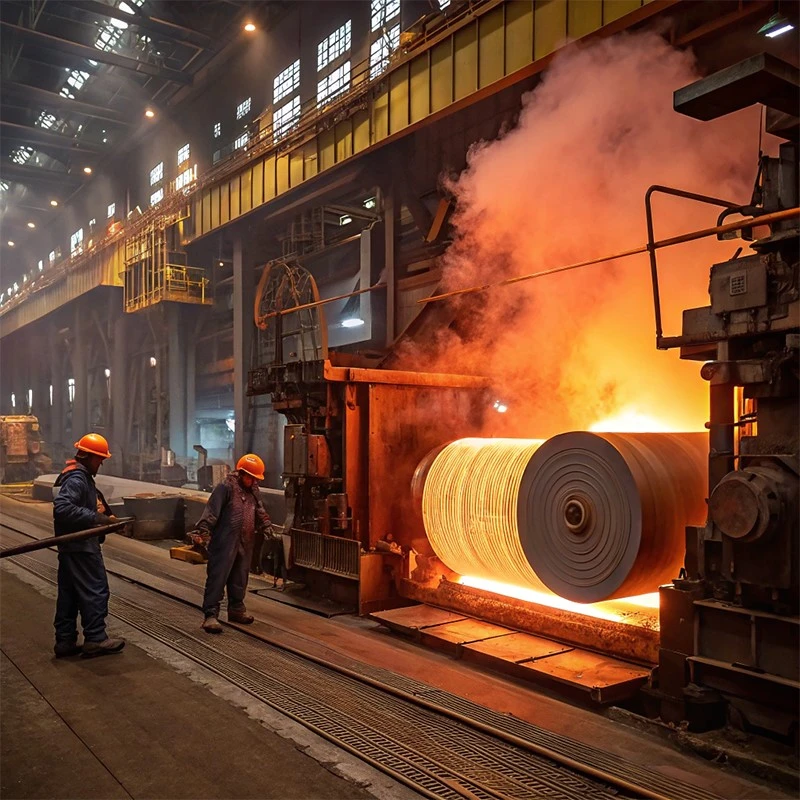
The working process of the hot rolling machine can be divided into several key stages, which are explained based on the characteristics of the hot rolling process in metal processing and non-woven material production:
1. Raw material preparation and heating
Raw material treatment: Using steel billets or continuous casting billets as raw materials, the temperature needs to be raised above the metal recrystallization temperature (usually around 80% of the solidus temperature) in the heating furnace.
Temperature control: The heating temperature needs to be determined according to the alloy phase diagram to ensure the improvement of material plasticity and the reduction of deformation resistance.
2. Rolling process
Coarse rolling and fine rolling:
The coarse rolling unit initially reduces the thickness of the billet, and the fine rolling unit further rolls it to the target size.
Rolling pressure (2.5 - 7 × 10³ N/cm) causes the material to undergo deformation heat, and the temperature can be further increased by 30 - 40°C.
Clapeyron effect: The polymer melting temperature increases under high pressure (e.g., polypropylene about 38°C/kbar), and the rolling temperature and pressure need to be precisely controlled to match the effect.
3. Cooling and forming
Laminar cooling: The rolled strip after fine rolling is rapidly cooled to the set temperature through the water cooling system.
Coiling: The cooled steel strip is wound into a coil by the coiler, and subsequent processes such as edge trimming and straightening can be carried out.
4. Equipment and process characteristics
Two-roll hot rolling machine structure: It includes the main machine drive, hydraulic system, online cooling raceways, etc., and supports the switching between hot rolling and cold rolling modes (opening width 50mm/5mm).
Advantages: Low energy consumption, capable of improving the metal structure (such as breaking large coarse grains), suitable for large-scale production.


