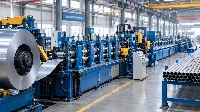
An essential piece of machinery in the metalworking and manufacturing industries, has revolutionized the production of seamless and welded tubes across various sectors. This versatile machine is renowned for its precision, efficiency, and ability to handle a wide range of materials, from stainless steel and carbon steel to alloys and non-ferrous metals.
The core function of a tube mill lies in its ability to continuously form flat strips or coils of metal into round or shaped tubes through a series of forming stages. This process begins with the uncoiling of metal strips, which are then fed into the mill's forming section, where a series of rollers gradually bend the metal into the desired shape and diameter. The precision of these rollers is crucial in ensuring the dimensional accuracy and structural integrity of the resulting tubes.
After forming, the tubes undergo welding (in the case of welded tubes) where the edges of the strip are fused together to create a seamless joint. For seamless tubes, the process involves piercing a hole through the center of the metal strip, followed by elongation and reduction to achieve the final tube dimensions. Both processes require meticulous control of temperature, pressure, and speed to ensure high-quality output.
The tube mill's efficiency stems from its automation capabilities, allowing for continuous production at high speeds with minimal human intervention. This not only increases productivity but also reduces labor costs and the potential for human error. Moreover, modern tube mills are equipped with advanced control systems that enable real-time monitoring and adjustment of production parameters, ensuring that the tubes meet stringent quality standards.
The versatility of the tube mill extends to its ability to produce tubes of varying sizes, wall thicknesses, and lengths, catering to the diverse needs of the automotive, construction, oil and gas, aerospace, and many other industries. From high-pressure pipes for hydraulic systems to lightweight tubing for bicycles and furniture, the tube mill plays a pivotal role in shaping our modern world.
In conclusion, the use of the tube mill represents a pinnacle of engineering excellence, enabling the efficient and precise production of tubes that are critical to numerous industries. Its continued evolution and advancement will undoubtedly pave the way for even more innovative and efficient tube manufacturing processes in the future.