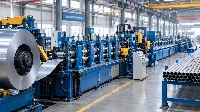
Tube mill sizing lines are an essential part of the manufacturing process for seamless steel pipes. These pipes are used in various industries including construction, energy, and transportation. In this article, we will explore the world of tube mill sizing lines and provide an overview of the different stages involved in the pipe production process.
1.Material Selection:
The first step in the pipe production process is the selection of raw materials. Seamless steel pipes are typically made from low-carbon steel, which has a carbon content of less than 0.3%. The grade of steel chosen depends on the application and performance requirements of the final product. Special attention is paid to the mechanical properties, such as tensile strength, yield strength, and hardness, among others.
2.Blanking:
Once the raw material is selected, the next step is to create blanks or cylindrical shapes that will serve as the foundation for the seamless steel pipe. This is achieved through a process called blanking, where a large sheet of steel is cut into circular blanks using a press or shear machine. The blanks are then prepared for the sizing process.
3.Pipe Expansion:
After the blanks are created, they undergo a sizing process to bring them to their final diameter and wall thickness. This is achieved through a series of passes through a set of dies that gradually force the blanks to expand. The dies are designed to correct any initial ovality or out-of-round conditions present in the blanks. Pipe expansion ensures a uniform wall thickness and roundness of the pipe, resulting in better quality products.
4.Wall Thickness Control:
After expansion, the seamless steel pipe undergoes a series of wall thickness control systems to ensure that it meets the required wall thickness tolerances. This involves monitoring the wall thickness using gauges and sensors, and adjusting the production parameters accordingly to maintain consistent quality.
5.Surface Finishing:
The seamless steel pipe undergoes a surface finishing process to remove any roughness or imperfections present on its surface. This can involve various techniques such as sandblasting, shot peening, or polishing to achieve a smooth and clean surface finish. Surface finishing enhances the appearance and corrosion resistance of the pipe while also improving its mechanical properties.
6.Inspection and Testing:
Finally, the seamless steel pipes are inspected and tested to ensure that they meet the required quality standards. This includes visual inspections for surface defects and dimensional accuracy, as well as mechanical testing to evaluate strength and durability. The pipes that fail to meet the specified standards are rejected and may require reprocessing. Inspection and testing ensure that only high-quality products are shipped to customers.
Tube Mill Sizing Lines play a crucial role in the manufacturing process of seamless steel pipes, ensuring that each pipe meets the required dimensions, surface finish, and mechanical properties. The pipe production process involves multiple stages from raw material selection to packaging and shipping, each of which contributes to the overall quality and usability of the seamless steel pipe.