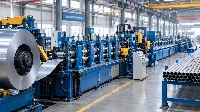
The tube mill, an integral piece of machinery in the metalworking industry, serves a crucial function in the production of seamless tubes and pipes. Its primary purpose is to transform metal sheets or strips into hollow, cylindrical structures with precise dimensions and properties, suitable for a wide range of applications.
The process begins with the feeding of metal stock, typically steel, aluminum, or stainless steel, into the mill. Through a series of rotating rolls, the material undergoes progressive reduction in thickness and shaping, eventually forming a seamless tube. The rolls are strategically positioned and engineered to apply pressure and deformation to the metal, guiding it into the desired form while ensuring structural integrity and surface quality.
The tube mill's function is not limited to shaping alone; it also plays a significant role in controlling the material's microstructure, enhancing its strength, and improving its overall performance. Heat treatment processes, such as annealing or quenching, may be incorporated within the mill or as a subsequent step to further refine the properties of the finished tube.
Moreover, modern tube mills are equipped with advanced automation and control systems, enabling precise adjustments to the manufacturing process based on real-time feedback. This ensures consistency in product quality, reduces waste, and increases production efficiency.
In summary, the tube mill is a vital tool in the production of seamless tubes and pipes, transforming metal sheets into precision-engineered components for industries such as oil and gas, construction, automotive, and aerospace. Its function encompasses shaping, enhancing material properties, and ensuring product quality, all while maximizing efficiency and reducing waste.